
From painful process to working software.
No mystery, no jargon, no six-month silence before a big reveal. You see screens before we build, and working software early. Here's the shape of it.
It starts with a free process review.
Before anyone talks about a project, we look at one process together. It costs you thirty minutes and nothing else.
Pick one process
The order book, the quoting, the scheduling, whichever one hurts most. We only need one to start.
Walk us through it
Thirty minutes, on a call or in person. Show us how the work actually moves, warts and all.
Get a straight answer
Whether software would genuinely pay for itself, roughly what it would involve, or an honest 'you don't need us'. No obligation either way.
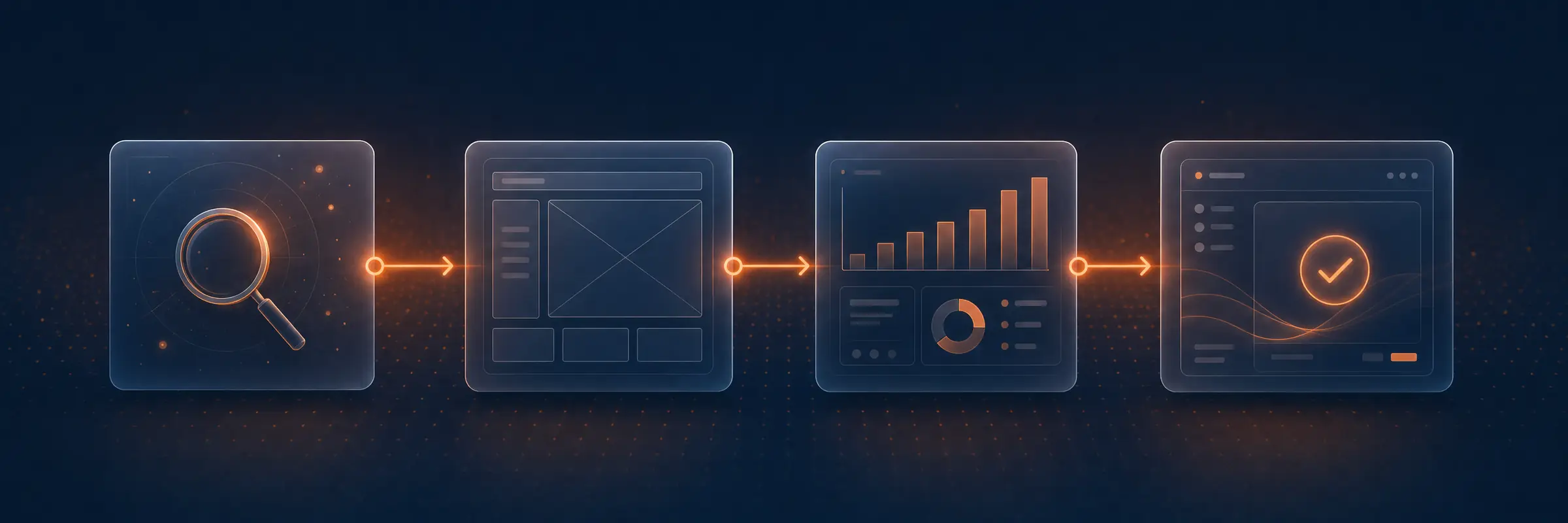
Four steps, no surprises.
The same shape whether it's a small automation or a full system. The steps stay honest because we've been on the receiving end of the other kind.
01
Discover
We sit with the people who do the work and map how it actually happens, not how the org chart says it does. That's where the time and money leak, and it's where the build starts.
02
Design
You see screens before anything is built. Prototypes first, so we agree what matters while it's still cheap to change your mind.
03
Build
Working software in increments you can actually use, not a big reveal after six months. Built in the UK on a modern web stack.
04
Run
We host it, support it and keep improving it as the business changes. You're never left holding software nobody looks after.
What it costs, and how to tell if it's worth it.
We quote per piece of work rather than publishing a price list, because an honest number depends on your process, your integrations and your data. What we can give you up front is what moves that number, and a sum you can do yourself.
How many processes
One process done properly is a project. Five are five projects, and they want doing in order rather than at once.
How many rules and exceptions
A rule you can state in one line is cheap. A rule that lives in one person's head with fourteen exceptions is where the time goes.
Integrations and data
Every system it must talk to is real work, and so is fifteen years of history with three spellings of the same customer.
Then do the arithmetic before you talk to anyone: count the hours a week the process eats across everyone who touches it, multiply by a loaded hourly cost, multiply by 46 weeks. That annual figure is what any quote should be measured against — and if it comes out small, we'll tell you software isn't the answer.
The full cost breakdownThe questions to ask before you commit to anyone.
Including us. A supplier who gets uncomfortable when you ask what happens if you part company is telling you something useful.
Who owns the code?
Ask before work starts, not after. In England and Wales the developer owns commissioned software by default unless it's assigned in writing — an invoice marked paid doesn't do it.
Can you get your data out?
In a documented format, on request and on termination, as a stated right rather than a favour. It's your data and, where it's personal data, your responsibility too.
Could someone else pick it up?
Standard, widely used technology and a real handover — how it's deployed, what it depends on, where the secrets live. Owning a car doesn't make you a mechanic.
What happens if we stop working together?
The answer should be dull and already written down. A licence that ends with the relationship, on software you trade on, is the one to catch now.
What you're not signing up for.
No licence-per-seat surprises, no offshore handover, no system that stops evolving the day it goes live. You deal with the person who builds it, before, during and after.
We'd rather tell you software isn't the answer than build something that gathers dust. The free review exists so both sides find that out early, while it's still free.
Got a process that hurts?
Book a free process review. Thirty minutes, one process, and an honest answer on whether software would pay for itself.